Pain, swelling, drainage, bleeding, or a new lump after previous pilonidal treatment does not automatically mean that EPSiT is the next step. You will learn how clinicians confirm the cause, identify urgent problems, assess whether the sinus anatomy suits endoscopic treatment, and compare EPSiT with drainage or other operations.
Key takeaways
- Seek urgent care for fever, spreading redness, severe pain, or difficulty sitting.
- Recurrence can follow drainage, excision, flap surgery, pit-picking, or earlier EPSiT.
- A clinician confirms recurrence by examining pits, drainage, scars, and abscesses.
- EPSiT suits selected cases; an active abscess usually needs drainage first.
What counts as recurrence, and when is it urgent?
Recurrence means symptoms return after treatment, whether the original sinus remained or a new one formed. Recurrent pilonidal symptoms include repeated pain and swelling, drainage, bleeding, or foul-smelling discharge from the natal cleft after incision and drainage, pit-picking, excision, flap surgery, or earlier EPSiT.
New midline pits, renewed hair or debris, or persistent discharge need reassessment; they do not automatically mean another EPSiT is required.
Seek urgent medical assessment rather than waiting for a routine procedure consultation if you have:
- A lump that is enlarging rapidly or severe, escalating pain.
- Redness spreading beyond the cleft, fever, or chills.
- Difficulty sitting or walking because of swelling or pain.
- Heavy bleeding, worsening discharge, or feeling faint or acutely unwell.
A painful, fluctuant lump suggests a pilonidal abscess: trapped pus has made the tissue soft and compressible. An acute abscess often needs opening and drainage before anyone decides whether EPSiT is suitable, because inflammation and pus can hide the sinus tracks.
After the infection settles, a clinician can examine the pits, openings, scars, and drainage pattern. Similar symptoms can come from an infected skin cyst, hidradenitis suppurativa, an anal fistula, or another abscess, so do not self-diagnose based on location alone.
How does a clinician confirm that the problem is a recurrent pilonidal sinus?
Drainage near the buttock cleft does not confirm a diagnosis of recurrent pilonidal disease. A clinician needs a pilonidal sinus examination because pain or discharge can come from a different condition, including hidradenitis suppurativa, an infected epidermoid cyst, an anal fistula, Crohn-related disease, or another skin abscess.
The clinician inspects the natal cleft for midline pits, secondary openings, sinus tracks, abscesses, and scar tissue. They assess whether the problem is a persistent branch left after earlier treatment, a new sinus, or an acute abscess that needs drainage before definitive treatment.
Bring details that help connect the current findings with your treatment history:
- Previous operation or drainage records, including the procedure name and date
- The date symptoms restarted
- The number of flare-ups and how frequently they occur
- Photographs showing swelling, an open pit, or drainage
- Antibiotic names, doses if known, and treatment dates
- Details of slow wound healing, wound separation, or infection
Imaging is not ordered automatically. Ultrasound, magnetic resonance imaging, or another scan is usually reserved for unclear diagnoses or unusually extensive anatomy, such as suspected branching tracks or disease extending beyond the natal cleft. A painful, fluctuant abscess can also make examination less definitive until the acute inflammation settles.
Which features make recurrent disease more or less suitable for EPSiT?
EPSiT eligibility depends on the tract’s anatomy, not simply on how many times symptoms have returned. The clinician examines the number and location of pits, whether openings stay in the midline or extend laterally, the tract length and branching, the amount of scar tissue, and whether disease reaches beyond the natal cleft.
| Feature | More suitable for EPSiT | Less suitable for EPSiT |
|---|---|---|
| Pits and openings | Few, accessible pits with limited secondary pilonidal openings | Numerous pits, widely separated openings, or lateral extensions |
| Sinus tract branching | Short tract with little or no branching | Long, branching tracks with persistent side branches |
| Current condition | Chronic drainage without an active abscess | Painful, fluctuant abscess or spreading acute inflammation |
| Previous treatment | Limited alteration of the cleft’s anatomy | Scar tissue after pilonidal surgery, repeated drainage, excision, flap surgery, pit-picking, or earlier EPSiT |
| Disease location | Confined to the natal cleft | Tracts extending well beyond the cleft |
Earlier procedures can distort normal landmarks and leave scar tissue that hides a side branch. A large branching system formed after several operations is not equivalent to a simple sinus, even when the external wound looks small.
During EPSiT, an endoscope can reveal hair, pus, granulation tissue, and secondary openings through a pit. That view helps the surgeon clean and cauterize the tract, but it cannot make inaccessible or extensive disease simple. The decision follows examination and considers whether you can keep the treated cleft clean and dry afterward.
Why an abscess may need drainage before definitive treatment
An acute, fluctuant abscess usually needs incision and drainage before EPSiT. Trapped pus and active inflammation distort the sinus and can prevent accurate assessment or effective endoscopic cleaning. Trying to treat it immediately can leave infected cavities or hidden branches behind.
Treatment timing usually follows this sequence:
- Drain the abscess through an opening, release the pus, and control the acute infection.
- Allow swelling and inflammation to settle, then reassess the remaining pits, openings, scar tissue, and sinus tracks.
- Choose definitive treatment based on that examination: EPSiT, staged treatment, combined management, or another operation.
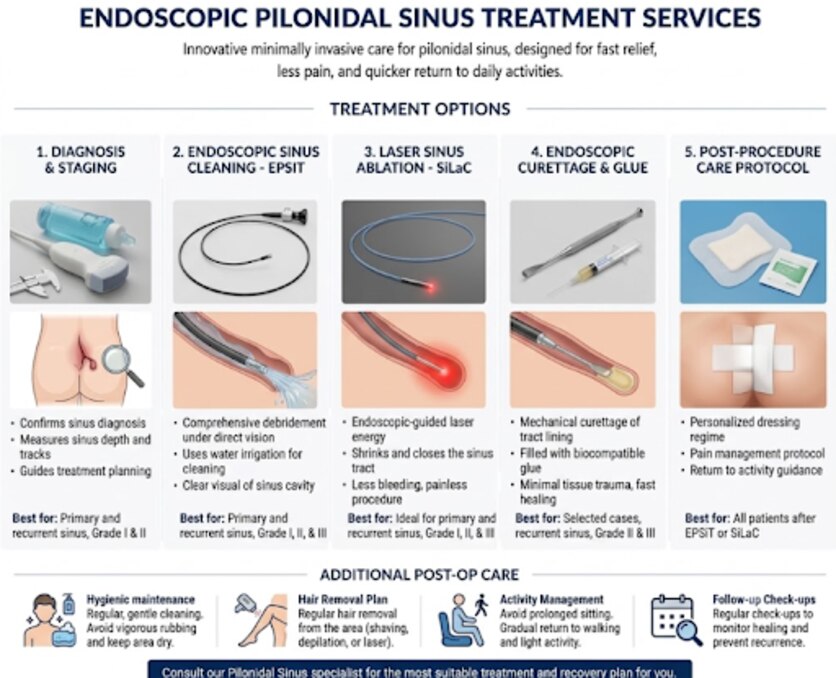
EPSiT inserts a small endoscope through a pit. Under direct vision, the surgeon removes hair, pus, and unhealthy granulation tissue, then cauterizes the tract. It is not simply a small incision that leaves the sinus untreated.
For extensive or repeatedly recurrent disease, an off-midline flap can be more appropriate than an endoscopic procedure. Guidelines have a stronger evidence base for off-midline closure than midline closure because midline closure has higher wound-complication and recurrence rates.
Published studies are mostly small cohorts and case series. The EPSiT recurrence rate is roughly 2% to 10% in many short-term reviews, with higher figures in some longer follow-ups.
Reported EPSiT recovery time averages 1–7 days to usual activity and 2–8 weeks for wound healing, but infection, a large cavity, persistent drainage, or repeated procedures can extend it.
What should you ask before choosing a procedure?
Before choosing EPSiT, establish exactly what needs treatment: an acute abscess, a persistent sinus, or another condition such as an infected cyst, hidradenitis, or anal fistula. Ask these questions before EPSiT:
- How many pits and branches were found, and does any tract extend outside the midline cleft?
- Why is EPSiT preferable to drainage, repeat excision, or an off-midline flap for this anatomy?
- If you find an unexpected side branch, will you treat it during the same procedure or plan another operation?
- What postoperative wound care will I need, including dressings, bathing, drainage, and review?
- What is the expected timetable for sitting, working, exercising, and driving?
- What new pit, drainage, swelling, fever, redness, or pain would indicate another recurrence?
| Option | Main advantage | Main concern |
|---|---|---|
| Drainage | Relieves trapped pus during an acute abscess | Does not remove the chronic sinus |
| Repeat excision | Removes visible sinus and scarred tissue | A larger wound and possible wound-healing problems |
| Off-midline flap | Moves the cleft incision away from the midline | More extensive surgery and flap-specific risks |
| EPSiT | Directly inspects and cleans selected tracts | Branching or extensive disease may remain difficult to treat |
Ask for a written plan for hair control after pilonidal treatment. The operation does not remove the cleft’s tendency to retain hair and moisture, so keep it clean and dry; use clinician-approved clipping, shaving, or laser, since aggressive self-shaving can irritate skin.
A pilonidal surgery consultation Pune patients attend at BariFit By Dr Parmeshwar can include review of prior records, examination findings, anatomy, and recovery timing before selecting a procedure.
Frequently asked questions
What counts as recurrent pilonidal sinus disease?
Recurrence means pain, swelling, drainage, bleeding, or foul-smelling discharge returns after earlier treatment, including drainage, pit-picking, excision, flap surgery, or EPSiT. Symptoms can arise from a persistent sinus or a newly formed one.
When are recurrent pilonidal symptoms urgent?
Seek prompt medical assessment for fever, rapidly increasing swelling, severe pain, spreading redness, pus, or difficulty sitting or walking. These signs can indicate an abscess or spreading infection.
How is recurrent pilonidal sinus confirmed?
A clinician examines the natal cleft for pits, openings, scars, tenderness, swelling, drainage, and an abscess. They review previous procedures and symptom timing. Imaging is not routine but may be considered when the diagnosis or extent is unclear.
Why might an abscess need drainage before EPSiT?
An abscess is a trapped pocket of pus. Incision and drainage relieve pressure and control the acute infection; definitive sinus treatment is planned after the inflammation settles.
Which recurrent cases may be considered for EPSiT?
EPSiT may be considered when the recurrent sinus has identifiable pits and tracts that can be reached endoscopically, without a large untreated abscess or extensive disease requiring another approach. A surgeon decides after examination.