Bright-red blood after a bowel movement is not always an emergency, but black stool, heavy bleeding, faintness, severe pain or a rapidly enlarging lump needs faster action. You will be able to sort bleeding and swelling into urgent warning signs, likely symptom patterns and situations that need a proper examination rather than repeated home treatment.
Key takeaways
- Seek urgent care for heavy bleeding, dizziness, black stools or severe worsening pain.
- Bright-red blood can come from piles or a fissure; colour alone cannot confirm the cause.
- Arrange an examination for recurrent bleeding, persistent symptoms or a new anal lump.
- Increase fibre, fluids and gentle bowel habits, but stop self-treatment if symptoms continue.
Which bleeding patterns need urgent assessment?
Bright-red blood on toilet paper often comes from an anal fissure or hemorrhoid, especially after straining, but colour alone cannot prove the source. The amount and pattern matter more:
| Pattern | What it can suggest |
|---|---|
| Bright-red blood on toilet paper | Bleeding near the anus, including hemorrhoids or a fissure |
| Blood dripping into the bowl | More than surface streaking; seek assessment if repeated or increasing |
| Blood mixed with stool | Bleeding higher in the bowel, including polyps, cancer or inflammatory bowel disease |
| Blood clots in stool or dark maroon stool bleeding | A larger or faster bleed that needs prompt medical evaluation |
| Black tarry stool | Digested blood from the stomach or upper digestive tract; treat as urgent |
Seek urgent medical assessment for heavy or continuous bleeding, black tarry stool, dizziness, fainting, marked weakness, rapid heartbeat or severe abdominal pain. Do not wait for routine piles care.
Arrange investigation when bleeding recurs, is mixed with stool, accompanies altered bowel habits or causes iron-deficiency anaemia, even when hemorrhoids are visible. A clinician may recommend colon evaluation if the source remains uncertain, symptoms persist after piles treatment, screening is overdue, or you have a family history of bowel cancer or polyps.
Finding hemorrhoids does not exclude another cause.
When does pain or swelling need urgent care?
A painful or swollen anal lump should not automatically wait for a routine appointment. Use the pattern and speed of change to decide how quickly you need examination.
| Finding | What it may indicate | What to do |
|---|---|---|
| Sudden painful bluish lump at the anal edge | Thrombosed external hemorrhoid; pain often peaks within 48–72 hours | Arrange early review if pain is severe, since selected cases benefit from early treatment |
| Severe constant pain with pus and fever with anal pain, chills or spreading redness | Perianal abscess | Seek prompt examination; drainage is usually needed, and antibiotics alone are not a substitute |
| Internal hemorrhoid that cannot be pushed back, turns dusky or black, or becomes increasingly painful | Incarcerated or strangulated prolapse | Seek urgent assessment; do not repeatedly or forcefully push it back |
A thrombosed external hemorrhoid can settle with pain relief, stool-softening measures and observation, but severe symptoms deserve early clinical review. Do not cut, puncture or squeeze the lump yourself.
A perianal abscess can worsen quickly and requires examination to locate the infected pocket and drain it safely. Go urgently if the swelling enlarges rapidly, pain becomes severe, or you develop fever, chills, weakness or spreading redness.
How can you distinguish piles from a fissure or another cause?
The anal fissure versus piles distinction often starts with pain. A fissure causes tearing or cutting pain during a bowel movement and tearing pain after bowel movement, sometimes lasting minutes or hours. Piles more commonly cause painless bright-red blood on toilet paper or in the bowl, or a lump.
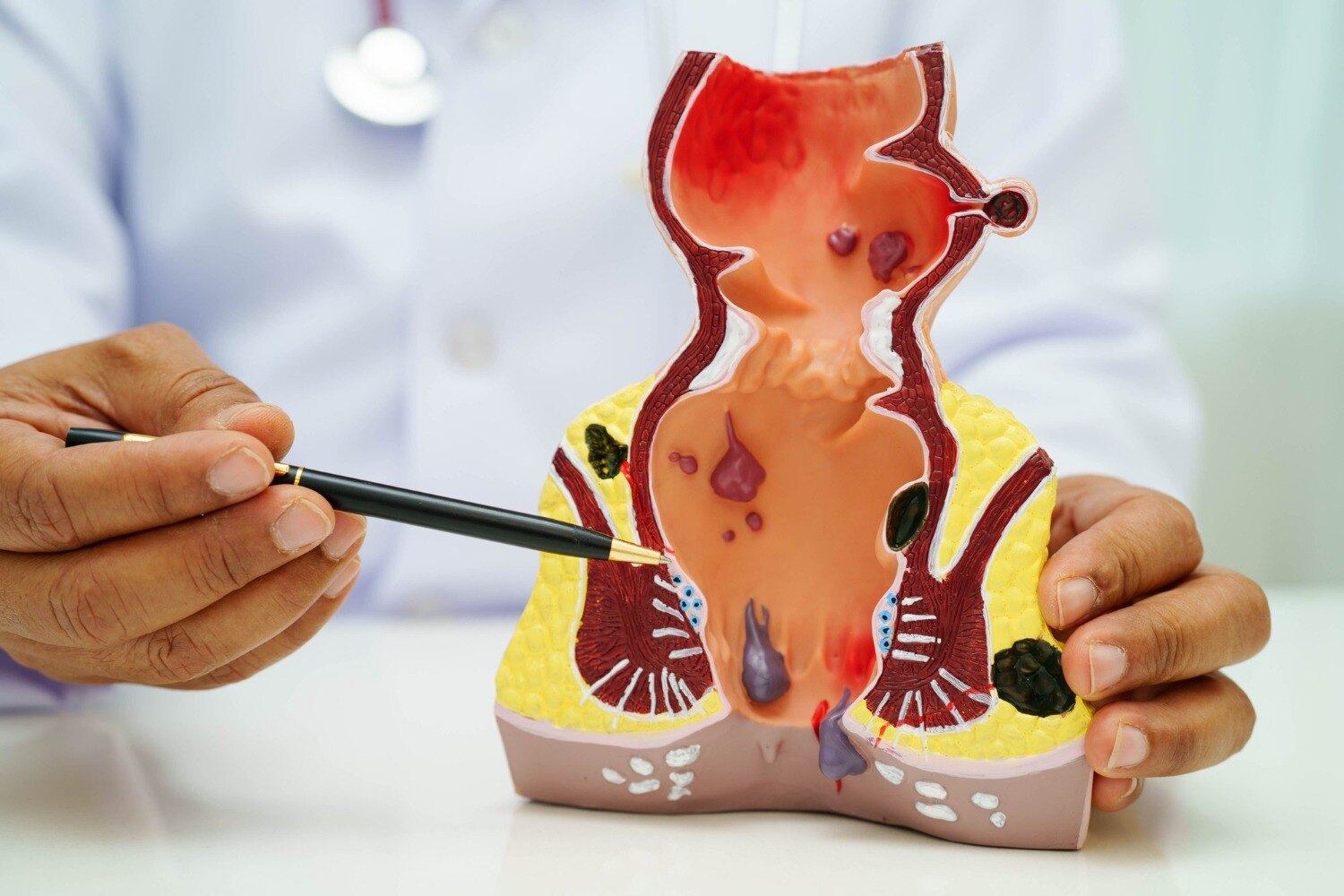
- Internal hemorrhoids can bleed or prolapse, producing tissue that bulges through the anus during straining.
- External hemorrhoids symptoms include a lump or tenderness at the anal opening; a suddenly painful bluish lump may be thrombosed.
- Pain focused at the anal edge, especially after hard stool, points toward a fissure but does not confirm it.
- Itching, mucus, leakage or discomfort can occur with hemorrhoids and other anal conditions, so these symptoms alone cannot identify the cause.
Rectal bleeding also comes from colorectal polyps, colorectal cancer, inflammatory bowel disease, diverticular bleeding or bleeding higher in the digestive tract. Persistent bleeding, blood mixed with stool, abdominal pain, a new bowel-habit change, iron-deficiency anaemia or a family history of bowel cancer or polyps raises the need for broader evaluation, even when hemorrhoids are visible.
A clinician may need to examine the anal canal and consider colon evaluation.
When should you arrange a piles consultation?
Arrange a consultation when symptoms cross a simple one-week threshold or keep returning. Use this checklist for when to see a piles specialist:
- Bleeding recurs, even if it is bright red.
- Pain continues beyond the bowel movement.
- Swelling does not settle.
- A new lump appears.
- Symptoms last more than about one week.
- Symptoms return after home care.
The clinician will ask about blood colour and amount, how long it has been present, bowel habits, straining, constipation, pregnancy, medicines such as anticoagulants, and any family history of bowel cancer or polyps. These details help separate hemorrhoids from fissures and other causes.
The examination may include inspection of the anal area, a digital rectal examination, and anoscopy for hemorrhoids or proctoscopy when indicated. These steps locate the bleeding source and assess prolapse, fissures, lumps and inflammation.
Further colon evaluation depends on the examination findings, your colorectal screening status and risk factors. A clinician may recommend it when the source remains uncertain, bleeding persists after hemorrhoid treatment, screening is overdue, or you have a family history or iron-deficiency anaemia. Visible hemorrhoids do not exclude a second cause.
What can you try first, and when is it not enough?
Start with piles home treatment that reduces constipation and straining, not just discomfort. Aim for about 14 grams of fibre per 1,000 calories—roughly 25 grams daily for many adult women and 38 grams for many adult men. Fibre can improve bleeding and overall hemorrhoid symptoms, but a sudden increase can cause bloating.
- Add psyllium fibre for hemorrhoids gradually, following the product directions, and drink enough fluid to prevent harder stools.
- Treat constipation with consistent fibre, fluids and medical advice if diet changes do not help.
- Avoid prolonged toilet sitting. Go when you need to, but do not scroll or strain on the toilet.
- Use an over-the-counter piles cream or suppository only as a short-term aid. Topical corticosteroids, local anaesthetics and vasoconstrictors should not be used indefinitely.
Arrange a review if symptoms do not improve after about one week, bleeding recurs, or you need repeated treatment courses. Seek assessment sooner if constipation and straining continue despite these changes, because ongoing pressure can keep triggering bleeding, swelling and prolapse.
Which piles treatments may be considered after examination?
Observation is reasonable when symptoms are mild, bleeding has been assessed, and prolapse is absent or settles without persistent discomfort. Office treatment is preferred for selected internal disease; surgery is reserved for anatomy and symptoms that office care cannot address.
| Option | What it means | When it applies |
|---|---|---|
| Observation | Fibre, stool-softening measures and monitoring | Mild symptoms without persistent bleeding, severe pain or troublesome prolapse |
| Rubber-band ligation | A band cuts off blood flow to an internal hemorrhoid above the pain-sensitive area | Grade I or II and some grade III disease; it does not treat external hemorrhoids |
| Excisional hemorrhoidectomy | The surgeon removes hemorrhoidal tissue | Large external components, combined disease, or grade III and IV hemorrhoids; expect more pain and a longer recovery |
| Stapled hemorrhoidopexy | A stapling device lifts prolapsed internal tissue | Selected internal prolapse when avoiding early postoperative pain matters; it cannot remove external tissue and has a higher recurrent-prolapse risk than excisional surgery |
Significant pain or bleeding after rubber-band ligation needs medical advice. At BariFit By Dr Parmeshwar in Kharadi, Pune, a colorectal or gastrointestinal surgeon can identify the bleeding source, grade prolapse and compare options instead of assuming every lump needs surgery.
Related services
Piles Treatment Piles, also known as hemorrhoids, are swollen veins in the rectum and anus that can cause pain, bleeding, itching, and discomfort during bowel... View service → |
Coloproctology Coloproctology Coloproctology is a specialized branch of surgery focused on the diagnosis, treatment, and management of diseases affecting the colon, rectum, anus,... |
Frequently asked questions
Which bleeding patterns from piles need urgent assessment?
Seek urgent assessment for heavy or continuous bleeding, clots, dizziness, fainting, weakness, black tarry stools, or bleeding with severe abdominal pain. Arrange a medical examination for recurrent bleeding or blood mixed through the stool.
When does pain or swelling need urgent care?
Seek urgent care for severe or rapidly worsening anal pain, a tense painful lump, fever, pus, spreading redness, inability to pass stool or urine, or heavy bleeding.
How can you distinguish piles from a fissure or another cause?
Piles may cause bright-red blood, itching, a lump or discomfort. A fissure more often causes sharp tearing pain during and after a bowel movement. These patterns overlap, so examination is needed for persistent, recurrent or unexplained symptoms.
When should you arrange a piles consultation?
Arrange a consultation when bleeding returns, symptoms last beyond a short period of home care, a lump remains painful, or you are unsure whether the problem is piles. Do not assume rectal bleeding is harmless.
What can you try first for mild piles symptoms?
Keep stools soft with fibre-rich foods, adequate fluids and a stool-softening plan recommended by a clinician. Avoid straining, prolonged toilet sitting and forceful wiping. Seek care if symptoms do not improve or worsen.