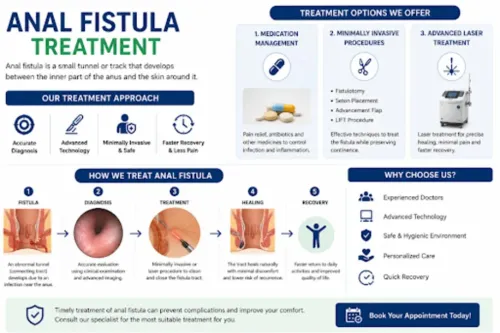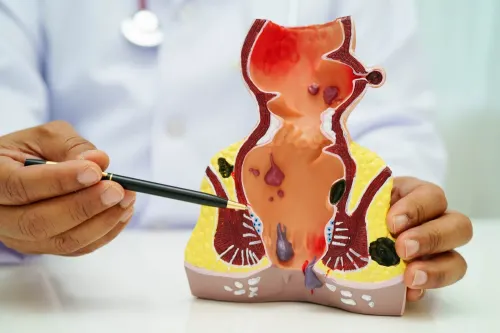
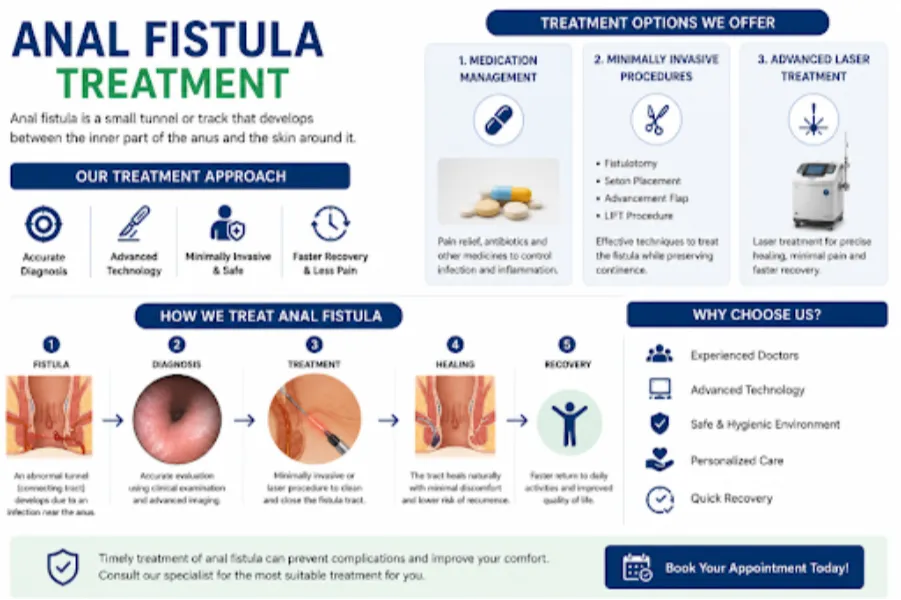
An anal fistula can cause a frustrating pattern of swelling, discharge and repeated infection. A painful abscess may settle after drainage, yet a small opening continues to release fluid later. This can happen because an abnormal tract remains between the anal canal and the surrounding skin.
Video-Assisted Anal Fistula Treatment is a minimally invasive technique designed to allow visualisation of the fistula tract from inside. For appropriately selected patients, this approach may form part of fistula management.
Patients in Kharadi and across Pune, Maharashtra, should understand that fistulas vary considerably in complexity, making accurate mapping and treatment planning particularly important.
Why Anal Fistulas Can Be Difficult to Treat
A fistula is not simply an external opening in the skin.
The tract may travel through or around muscles responsible for continence. Some fistulas have branches, multiple external openings or previous surgical changes.
This anatomy is one reason fistula treatment must balance two objectives:
- Treating the abnormal tract
- Protecting important sphincter structures where possible
The appropriate technique therefore depends heavily on the fistula's course.
How Video Assisted Treatment Works
During Video-Assisted Anal Fistula Treatment, specialised equipment allows the surgeon to inspect the fistula tract internally.
Direct visualisation can help identify the tract and its internal features. Treatment is then performed according to the technique and findings.
The minimally invasive nature of the procedure can make it attractive to patients, but suitability cannot be determined simply because someone has been diagnosed with a fistula.
What Needs to Be Assessed First
Before selecting treatment, the surgeon needs to understand the fistula anatomy.
Assessment may consider:
- Position of the external opening
- Suspected internal opening
- Relationship with sphincter muscles
- Previous abscesses
- Previous fistula procedures
- Number of tracts
- Recurrent infection
- Associated medical conditions
Imaging such as MRI may be recommended for selected complex or recurrent fistulas.
Why Comparing Procedures Requires Caution
Patients searching online may find several fistula treatments and assume the least invasive option must automatically be best.
That comparison can be misleading.
A straightforward fistula and a complex branching fistula may require completely different strategies. Procedures that are appropriate for one anatomical pattern may not be suitable for another.
The better question is not simply, 'Which procedure has the smallest wound?' It is, 'Which treatment is appropriate for the location and complexity of my fistula?'
Signs That Should Not Be Repeatedly Ignored
Persistent pus discharge, recurrent swelling near the anus, repeated abscess formation or an opening that never completely heals should be evaluated.
At BariFit By Dr. Parmeshwar, patients with fistula and other anorectal conditions can be assessed to determine the tract characteristics and available treatment approaches.
For patients in Kharadi and the wider Pune region, appropriate fistula care starts with defining the anatomy. Video-assisted treatment may be considered in selected cases, while other patients may require a different surgical strategy. Matching the procedure to the fistula pattern is central to responsible treatment planning.
Keywords