A hernia deserves more attention when it begins to ache, burn, feel tender, limit activity, grow, or become harder to push back. You will be able to distinguish changes that justify an elective surgical consultation from warning signs that require immediate hospital assessment, while understanding how the hernia’s location and your health affect the decision.
Key takeaways
- Seek review when pain, tenderness, pressure, or the bulge increases.
- Go to emergency care for severe pain, vomiting, or a trapped, discoloured bulge.
- Watchful waiting fits selected, minimally symptomatic hernias after clinical assessment.
- Discuss cough, constipation, diabetes, smoking, weight, and medicines before planned repair.
Which changes show that a hernia is becoming painful or larger?
A previously noticeable hernia deserves surgical review when symptoms increase or the bulge changes. A painful hernia may cause aching, pressure, tenderness, or a burning sensation over the hernia lump.
Pain when coughing, lifting, standing, walking, or exercise suggests it is affecting daily activity, although hip, bowel, urinary, nerve, and abdominal wall pain can mimic hernia pain.
| Change | What you notice | What it suggests |
|---|---|---|
| Pain pattern | Discomfort lasts longer, occurs more often, or becomes abdominal wall pain during work or exercise | Symptoms are progressing; discuss elective repair |
| Bulge size | The lump or bulge in the abdomen or groin measures larger, appears sooner when standing, or appears with less effort | A growing hernia is developing; arrange assessment |
| Reducibility | It takes longer to push the bulge back while lying down, or it no longer returns easily | The opening may be tightening around its contents; seek prompt review |
| Function | You stop lifting, coughing, walking, standing, or exercising because of pain | The hernia is no longer merely noticeable |
Track the bulge in the same position and note when pain occurs; photographs can help show change to a clinician. Size alone does not determine urgency: a large hernia can remain reducible, while a small opening can trap bowel.
A firm, very tender bulge that cannot be pushed back, especially with sudden constant pain, vomiting, abdominal swelling, fever, dark or red skin, or inability to pass stool or gas, requires emergency assessment rather than a routine appointment.
When does a hernia become an emergency?
A hernia needs immediate hospital assessment when a bulge becomes suddenly painful, firm, tender, and impossible to return. A reducible hernia flattens or slips back into the abdomen when you lie down and apply gentle pressure. An irreducible hernia cannot push back; this usually means it is incarcerated. Do not force it back yourself.
| Type | What you may notice | What to do |
|---|---|---|
| Reducible hernia | Bulge reduces when lying down or with gentle pressure; discomfort settles | Arrange routine surgical review if it enlarges or becomes painful |
| Incarcerated hernia | Bulge stays out, feels firm or tender, and cannot be reduced | Seek urgent hospital assessment |
| Strangulated hernia | Constant or severe pain, increasing tenderness, red or dark skin, and possible illness from impaired blood supply | Treat as an emergency; urgent operation may be needed |
Go to an emergency department immediately if you have:
- Severe constant pain or rapid deterioration
- A firm tender bulge, especially with red or dark skin
- Vomiting or fever
- Abdominal distension
- Inability or being unable to pass stool or gas
These symptoms can indicate bowel obstruction or a strangulated hernia. A small hernia opening can trap bowel, so size does not make it safe. A clinician may sometimes reduce an incarcerated hernia without blood-supply damage, but only after assessment.
When is watchful waiting reasonable, and how does location change the risk?
A small painless reducible inguinal hernia in a man can often be observed with a watchful waiting hernia plan. This does not repair the defect; arrange review if pain, activity limits, enlargement, or difficulty pushing it back develops.
End observation and contact a clinician when:
- The bulge becomes painful, tender, firm, or harder to reduce.
- It interferes with walking, lifting, coughing, work, or sleep.
- It grows or appears more frequently.
- You develop vomiting, abdominal swelling, fever, or inability to pass stool or gas; seek urgent hospital care for these signs.
Location changes the balance because the neck, contents, and surrounding tissue differ.
| Location | Why the decision differs |
|---|---|
| Inguinal | Minimally symptomatic men can often observe; symptoms or loss of reducibility favour repair. |
| Femoral | Women: femoral hernia risk is easily missed beside an inguinal bulge, and femoral hernias incarcerate more readily; timely repair is usually preferred. |
| Umbilical | Observe only when small, painless, and reducible; pain, enlargement, or a tight neck warrants review. |
| Incisional | A previous surgical opening can enlarge progressively, so worsening symptoms or a changing bulge needs assessment. |
| Epigastric | Fat may protrude through a small defect; persistent pain or difficulty reducing it supports repair. |
| Hiatal | This internal hernia causes reflux, chest or upper-abdominal discomfort, and swallowing problems rather than a skin bulge; treatment depends on symptoms and complications. |
How do clinicians confirm the hernia and compare repair options?
A clinician usually examines the bulge while you are standing and lying down, then asks you to cough or strain: this hernia examination standing coughing can reveal a defect that disappears when you lie down. The examiner checks whether the lump is tender, reducible, and located at the groin, navel, incision, or upper abdominal wall.
An ultrasound hernia study is commonly the first scan when examination is uncertain. A CT hernia scan can show the defect, bowel involvement, or complications, particularly in incisional or complex hernias. MRI is useful for an occult inguinal hernia after a nondiagnostic ultrasound, especially when groin pain persists but no bulge is visible.
Compare repairs on more than the incision size:
| Option | What to compare | Important trade-off |
|---|---|---|
| Open repair | Direct access, anaesthesia, mesh or tissue repair | Effective, but early wound pain can be greater |
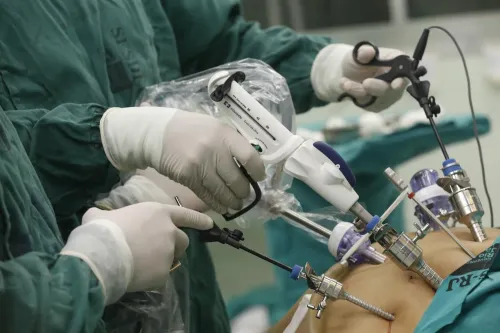
| Laparoscopic repair | Preperitoneal mesh placement and recovery time | Often less early pain; requires general anaesthesia and trained expertise |
| Robotic repair | Robotic control of a minimally invasive approach | Similar decision factors, with added equipment and operating complexity |
| Mesh repair | Reinforcement and lower recurrence for most adult groin hernias | Does not remove risks of infection, chronic groin pain, numbness, or recurrence |
| Repeat repair | Prior mesh, scar tissue, and the original approach | A recurrent hernia is commonly repaired through a different tissue plane |
Ask BariFit By Dr Parmeshwar to explain why the proposed approach fits your hernia type, previous operations, anaesthesia needs, and priorities rather than choosing by “open” or “robotic” alone.
What should you address before elective hernia surgery?
Book a hernia surgery consultation when a bulge becomes painful, enlarging, harder to reduce, or begins limiting walking, lifting, coughing, or work. A preoperative hernia assessment also checks whether the pain comes from the hernia rather than a hip, nerve, bowel, or urinary problem.
1. Stop smoking before elective repair. Smoking impairs wound healing and raises infection and pulmonary risk; set a smoking cessation plan early rather than stopping on the operating-day morning.
2. Improve diabetes control with your treating clinician. High blood glucose increases infection and wound problems, so the surgical and anaesthesia teams need your medication list and recent glucose results.
3. Correct malnutrition before surgery. Low protein intake or unintended weight loss can delay healing. Obesity also increases wound risk, anaesthetic risk, and recurrence risk, but an arbitrary weight target should not postpone repair indefinitely when the hernia is painful or worsening.
4. Complete anaesthesia and previous-operation reviews. Tell the team about sleep apnoea, lung disease, heart disease, medication reactions, prior abdominal incisions, mesh, and earlier repairs. Scar tissue and the old repair plane can change the safest technique.
A painful enlarging hernia deserves an updated timing decision, not automatic observation. If optimization takes weeks, ask how symptoms, reducibility, and activity limits should change the plan.
Frequently asked questions
Which changes suggest that a hernia is becoming painful or larger?
Arrange a surgical review if the bulge enlarges, becomes harder to push back, or causes increasing aching, pressure, tenderness, burning, or pain during coughing, lifting, or movement.
When does a hernia become an emergency?
Seek emergency care for sudden severe or persistent pain, a bulge that cannot be pushed back, vomiting, abdominal swelling, inability to pass stool or gas, fever, or skin turning red, purple, or dark.
When is watchful waiting reasonable for a hernia?
Watchful waiting can suit a small, reducible hernia with little or no discomfort after a clinician assesses it. Location, symptoms, and the chance of bowel becoming trapped determine whether observation is safe.
How do clinicians confirm a hernia and compare repair options?
Clinicians examine the bulge while you stand, cough, or strain. Ultrasound or CT can clarify an uncertain diagnosis. They compare open, laparoscopic, and robotic repair according to location, size, previous operations, health, and surgeon experience.
What should you address before elective hernia surgery?
Review smoking, diabetes control, excess weight, constipation, chronic cough, blood-thinning medicines, and previous abdominal surgery. Treating these issues can improve readiness and recovery.