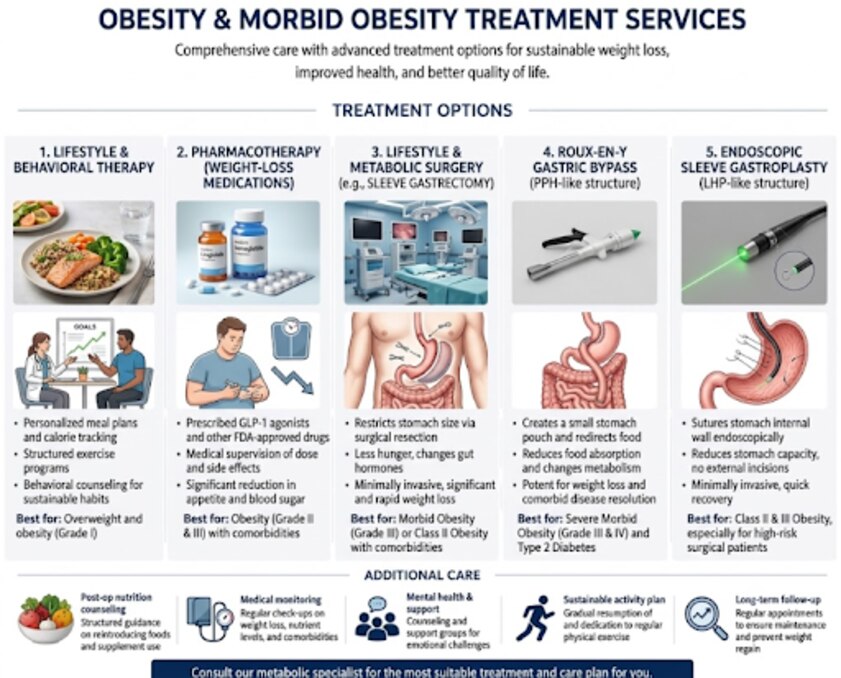
Choosing obesity treatment requires more than a BMI reading or a decision to have surgery. A structured pathway matches your health conditions, previous treatment, medication options, surgical risks, and ability to manage lifelong follow-up with the least invasive effective treatment.
Key takeaways
- BMI 40 or higher warrants a comprehensive obesity treatment assessment.
- Compare lifestyle care, medicines, endoscopy, sleeve surgery, and bypass by health needs.
- Treat sleep apnoea, diabetes, nutrition, and surgical risks before an operation.
- Plan lifelong follow-up, dietary changes, activity, and supplements after surgery.
When does obesity treatment need a structured assessment rather than a single weight-loss plan?
BMI 40 or greater, or BMI 35 or greater with obesity-related disease, is commonly described as class III obesity. Clinicians prefer this term to the older phrase morbid obesity because it describes severity without suggesting that a person is defined by illness or worth.
Use the BMI calculation: weight in kilograms divided by height in metres squared. A BMI of 100 kg and 1.6 m is 39.1. BMI is only a screening measure; it does not directly measure body fat, muscle, fat distribution, or individual health risk.
- Measure waist circumference and obesity risk alongside BMI, then assess metabolic health, blood pressure, type 2 diabetes, sleep apnoea, fatty-liver disease, reflux, and osteoarthritis.
- Review mobility, daily function, eating behaviour, mental health, medicines, previous weight-loss attempts, and readiness for long-term care.
- Apply lower BMI thresholds thoughtfully for Asian-Indian people, whose cardiometabolic risk can occur at lower BMI values than standard cut-offs suggest.
The 2022 ASMBS/IFSO guidance recommends metabolic and bariatric surgery for adults with BMI 35 or greater, and consideration of surgery at BMI 30–34.9 when metabolic disease remains inadequately controlled with nonsurgical treatment. Treatment still depends on health risk, functional status, eating behaviour, previous treatment response, and willingness to attend lifelong follow-up—not on BMI alone.
How do clinicians choose between lifestyle treatment, medicines, endoscopy, and surgery?
The choice starts with multidisciplinary obesity treatment, not a procedure list. A bariatric surgeon, physician, dietitian, psychologist or psychiatrist, anaesthetist, and relevant specialists review blood pressure, fasting glucose or HbA1c, lipid profile, liver function, sleep apnoea, nutritional deficiencies, mental health, eating patterns, substance use, and pregnancy plans.
They also check medication interactions, altered absorption, previous weight-management attempts, and readiness for long-term follow-up.
The review may recommend:
- Supervised weight management when health risks are manageable and structured eating, activity, and behavioural support remain realistic.
- Anti-obesity medication with reduced-calorie eating and physical activity. It is medical treatment, not a short-term dieting supplement; stopping an effective drug can cause substantial regain.
- Endoscopic bariatric procedures when a less invasive intervention suits the person’s anatomy, risk profile, and treatment goals.
- Sleeve gastrectomy or gastric bypass when expected metabolic benefit outweighs operative, nutritional, reflux, and absorption risks.
- Continued nonprocedural care when risks, preferences, pregnancy plans, untreated mental illness, or inability to follow follow-up make intervention unsuitable.
| Option | Main trade-off | Decision focus |
|---|---|---|
| Lifestyle care | Lowest procedural risk; requires sustained participation | Risk, readiness, and prior results |
| Medication | Reversible; regain can follow stopping | Conditions, interactions, cost, duration |
| Endoscopic procedures | Less invasive; variable durability | Anatomy and treatment goals |
| Sleeve gastrectomy | No intestinal bypass; reflux can worsen | Reflux and nutritional risk |
| Gastric bypass | Strong diabetes and reflux benefit; more absorption and deficiency issues | Medication and supplement management |
A coordinated bariatric evaluation, such as the pathway available through BariFit By Dr Parmeshwar in Kharadi, connects these decisions instead of treating surgery as an isolated appointment.
Related services
Obesity & Morbid Obesity Treatment Obesity & Morbid Obesity Treatment Obesity and Morbid Obesity are complex medical conditions characterized by excessive body fat that can significantly impact overall health and... View service → |
Bariatric / Weight Loss Surgery Bariatric / Weight Loss Surgery Bariatric Surgery, also known as Weight Loss Surgery, is a specialized medical treatment designed to help individuals with obesity and morbid obesity... View service → |
What must be addressed before an operation can safely proceed?
Elective surgery should wait for an untreated eating disorder, uncontrolled psychiatric illness, active substance use, inability to follow postoperative instructions, pregnancy, or a medical problem that makes anaesthesia unsafe.
These findings can delay surgery or rule it out until treated; anaesthesia clearance must confirm that the heart, lungs, blood pressure, diabetes, and other risks are adequately controlled.
A preoperative bariatric diet or liver-shrinking diet does not prove that you are unsuitable. It may reduce liver size before surgery or meet a local protocol. Mandatory weight loss should not be a universal barrier to bariatric surgery eligibility.
Prepare with a documented plan:
- Complete supervised weight management and diet education, including protein, fluids, portion size, and staged postoperative eating.
- Stop smoking or receive a cessation plan; assess alcohol use and treat active dependence before surgery.
- Build walking and strength gradually, and obtain dental or medical clearance when indicated.
- Review every medicine, including diabetes drugs, anticoagulants, supplements, and tablets whose absorption may change.
- Test and treat sleep apnoea, including consistent CPAP use when prescribed.
- Arrange preoperative blood tests, such as a complete blood count, glucose or HbA1c, liver function, iron, vitamin B12, folate, and vitamin D; obtain imaging only when indicated.
- Discuss contraception and pregnancy planning. Pregnancy after bariatric surgery is generally postponed for about 12–18 months, while weight and nutrition stabilise, with obstetric and nutritional follow-up.
How do sleeve gastrectomy and gastric bypass change the treatment decision?
Sleeve gastrectomy versus gastric bypass depends on the disease you need to change, not weight loss alone. Both usually produce substantial, durable loss, but neither guarantees remission or prevents later regain.
| Operation | Expected effects | Main trade-offs |
|---|---|---|
| Sleeve gastrectomy | Strong weight loss and diabetes improvement; no intestinal bypass; simpler drug absorption | Reflux after sleeve gastrectomy can begin or worsen; deficiencies still require supplements; later conversion to bypass may be needed |
| Roux-en-Y gastric bypass | Often greater gastric bypass diabetes response and stronger reflux improvement | Bypassed intestine increases micronutrient deficiency, dumping, ulcer, anastomotic and altered drug-absorption risks; revision is more complex |
Sleeve surgery removes most of the stomach while preserving intestinal continuity, so malabsorption and medication-absorption changes are usually less pronounced. Gastric bypass reroutes food around part of the stomach and small intestine, so you need lifelong vitamins and minerals, laboratory monitoring, and a medication review; extended-release or narrow-therapeutic-index drugs may need different treatment.
Both procedures carry major gastrointestinal-surgery risks:
- Bleeding, infection, venous thromboembolism, respiratory or anaesthetic complications, leak, stricture, gallstones, bowel obstruction, and reoperation.
Laparoscopic surgery is common and usually limits incision-related morbidity, but it does not remove serious risks. Laparoscopic and robotic bariatric surgery use different platforms; robotic surgery is a technique, not a separate indication. Surgeon experience, your anatomy, safety data, and local outcomes matter more than the platform label.
What does recovery require after bariatric surgery?
Recovery is a lifelong treatment commitment, not an operation followed by routine recovery. Bariatric surgery aftercare includes scheduled visits to adjust nutrition, review medicines and absorption, support mental health, and monitor reflux, diabetes control, physical activity, and weight regain.
Follow the care team’s staged plan:
- Progress from liquids to puréed or soft foods, then regular textures; advancing too quickly can cause pain or vomiting.
- Meet the protein target set by your dietitian or surgeon, drink enough fluid, and separate fluids from meals when instructed.
- Increase walking and other physical activity gradually rather than lifting heavily before clearance.
- Review diabetes, blood-pressure, pain, and other medicines; altered absorption can require a different dose or formulation.
- Discuss anxiety, depression, disordered eating, and changing relationships with food; psychological support remains part of treatment.
Lifelong vitamin supplementation and bariatric nutritional monitoring protect against deficiencies that can appear years later. Scheduled blood tests should check iron, vitamin B12, folate, vitamin D, calcium, and other nutrients, with supplements adjusted to the procedure and results.
Pregnancy is generally postponed for about 12–18 months while weight and nutrition stabilise; pregnancy later requires obstetric and bariatric monitoring.
New or worsening abdominal pain, persistent vomiting, inability to drink, fever, black stools, rapid heart rate, or shortness of breath can indicate postoperative complications. Seek immediate clinical assessment rather than trying dietary troubleshooting.
Frequently asked questions
When does obesity treatment need a structured assessment?
A structured assessment is important at BMI 40 or higher, or BMI 35 or higher with conditions such as type 2 diabetes, sleep apnoea, hypertension, or fatty liver disease.
How do clinicians choose between lifestyle treatment, medicines, endoscopy, and surgery?
Clinicians consider BMI, obesity-related conditions, previous weight-loss attempts, eating patterns, medication risks, surgical fitness, and the treatment’s expected durability.
What must be addressed before bariatric surgery?
Preoperative care includes medical evaluation, nutrition review, anaesthesia assessment, medication planning, sleep-apnoea management, and preparation for lifelong follow-up.
How do sleeve gastrectomy and gastric bypass differ?
Sleeve gastrectomy reduces stomach capacity without rerouting the intestine, while gastric bypass creates a small stomach pouch and reroutes food through part of the small intestine.
What does recovery require after bariatric surgery?
Recovery requires staged eating, adequate protein and fluids, prescribed supplements, gradual activity, wound monitoring, and scheduled clinical checks.
Related services
Sleeve Gastrectomy Sleeve Gastrectomy is one of the most commonly performed and highly effective bariatric surgery procedures for the treatment of obesity and morbid... View service → |
Gastric Bypass Surgery Gastric Bypass Surgery is one of the most effective and scientifically proven bariatric procedures for long-term weight loss and improvement of... View service → |